Truck AC Repair Roadside for Diesel Fleets
Need truck ac repair roadside in San Antonio? Get fast mobile diesel A/C diagnostics and on-site repair to reduce downtime and keep drivers moving.
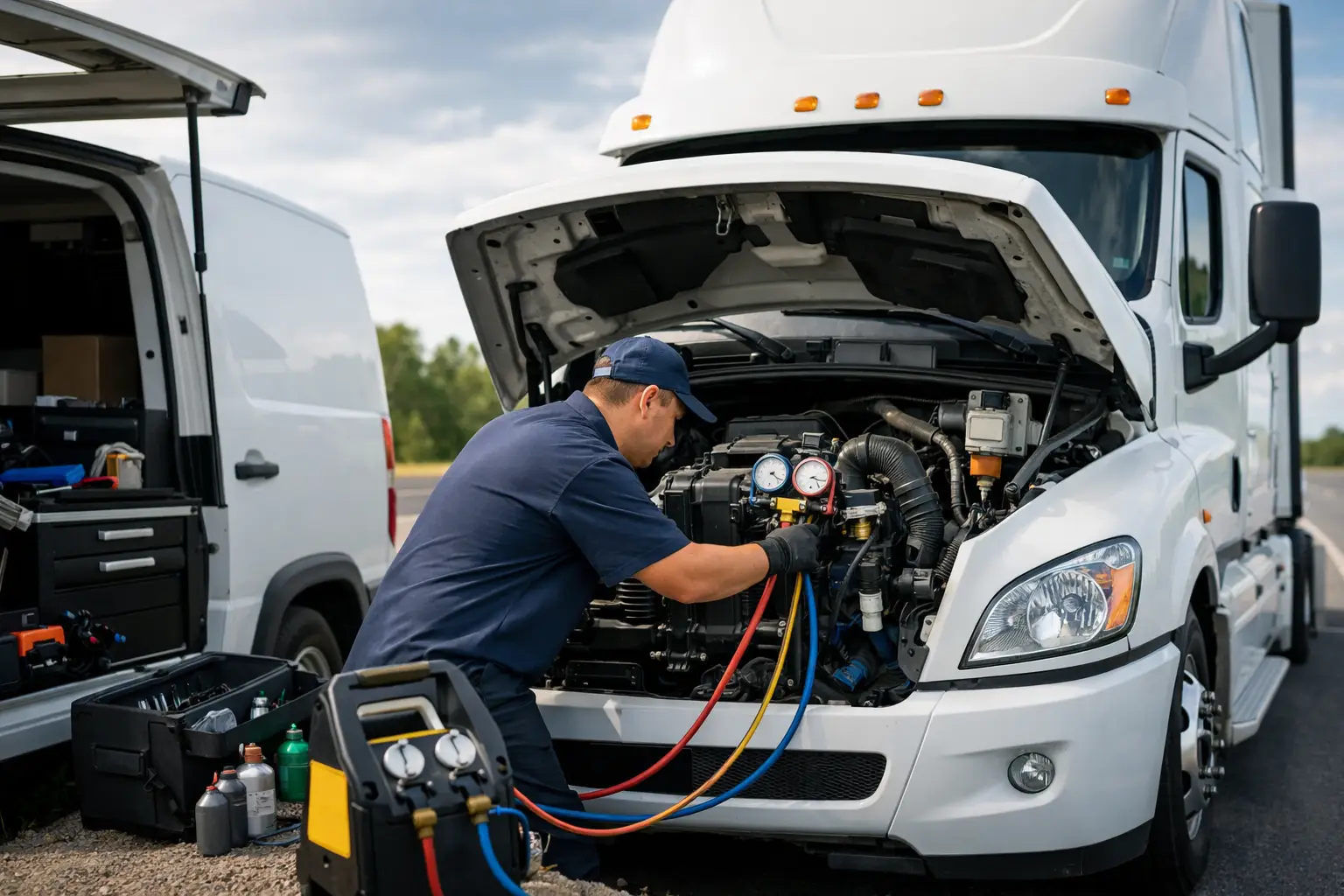
When the cab turns into an oven in South Texas, truck ac repair roadside stops being a comfort issue and becomes an operational problem. A driver who is overheating, losing focus, or stuck at a shipper with a dead A/C system is dealing with more than inconvenience. In this region, a failed air conditioning system can put delivery timing, driver endurance, and equipment uptime under real pressure.
For commercial trucks, A/C failures rarely happen at a good time. They show up in traffic on I-35, while idling at a receiver, or halfway through a run with a loaded trailer and no margin for delay. The right response is not guesswork. It is fast mobile diagnostics from a diesel technician who understands heavy-duty systems, electrical faults, compressor issues, refrigerant problems, and the difference between a temporary symptom and a real mechanical failure.
Why truck AC repair roadside matters
On a commercial diesel truck, air conditioning is tied to driver performance and daily operations. A hot cab wears a driver down fast, especially during long waits, stop-and-go traffic, or extended idle time in high heat. Fatigue increases, concentration drops, and the job gets harder than it already is.
There is also the issue of system damage. Running an A/C system that is low on refrigerant, cycling incorrectly, or dragging a failing compressor can turn a smaller repair into a larger one. What starts as weak cooling may be tied to a leaking hose, a bad pressure switch, a clutch issue, a condenser problem, or an electrical fault affecting fan operation. If the system is not diagnosed correctly on the roadside, the truck may keep moving, but the failure can get worse.
For fleets, the impact is straightforward. Downtime costs money, delayed routes affect customers, and driver complaints increase when a truck cannot maintain basic cab conditions. That is why roadside A/C service needs to be handled by a technician who can do more than recharge a system and hope for the best.
What causes roadside truck A/C failure
Heavy-duty A/C systems fail for a few common reasons, but the actual fault is not always obvious from the driver's seat. Weak airflow can feel like a refrigerant issue when the real problem is electrical. Warm air at idle can point to fan problems, pressure imbalance, or condenser performance. Intermittent cooling can come from clutch cycling, sensor faults, wiring issues, or restrictions in the system.
Leaks are one of the most common causes. Hoses, fittings, seals, condensers, and service ports can all develop leaks over time, especially on trucks that run hard in heat, vibration, and dirt. Low refrigerant is often a symptom, not the root problem. If a system is simply recharged without finding the leak, the truck is likely to be back in the same position again.
Compressors are another major failure point. A damaged compressor clutch, internal compressor wear, or contamination in the system can stop cooling fast. In some cases, the compressor is not the real issue at all. Power supply problems, blown fuses, failed relays, pressure switch faults, or control head issues can keep a good compressor from engaging.
That is where shop-level diagnostics matter. On a roadside call, the goal is not to throw parts at the truck. It is to isolate the failure, confirm what the system is doing, and make a repair that gets the truck back to work with confidence.
Truck AC repair roadside is not the same as light-duty A/C work
Commercial diesel trucks have different operating demands than smaller vehicles. They spend more time on the road, more time idling, and more time exposed to high heat loads. Access to components can also be more complex depending on cab layout, engine configuration, and the way the truck is equipped.
That means roadside A/C work on a diesel truck requires the right tools and the right technical approach. Pressure readings have to be interpreted correctly. Electrical checks need to be done under real operating conditions. Cooling complaints at highway speed may have a different cause than cooling complaints at idle. A technician has to understand the system as a whole, not just one part.
For owner-operators and fleet managers, this matters because a rushed fix can waste more time than it saves. If the truck leaves the roadside with the wrong repair, the load is still at risk and the schedule is still unstable.
What to expect from roadside A/C diagnostics
A proper roadside A/C service call starts with symptom verification. Is the system blowing warm air all the time, or only under certain conditions? Is airflow weak, or is the air strong but not cold? Is the compressor engaging? Are there signs of pressure imbalance, visible leakage, or electrical interruption?
From there, the technician checks system pressures, component operation, electrical inputs, and overall performance. Depending on the truck and the complaint, this may include checking the compressor clutch, inspecting hoses and fittings, testing switches and relays, confirming condenser and fan operation, and evaluating whether the system has lost refrigerant or is suffering from a control issue.
Not every roadside A/C problem ends the same way. Some failures can be repaired on-site and the truck can return to service quickly. Some require a component replacement and system correction to prevent repeat failure. In other cases, the issue may be tied to a broader electrical or engine-related problem affecting A/C operation. The key is knowing which situation you are dealing with before more time is lost.
When an A/C issue is urgent
Some drivers try to wait out an A/C problem until the next stop. Sometimes that works. Sometimes it does not. If cooling drops off sharply in extreme heat, the truck is idling heavily, or the driver is already dealing with long hours and traffic, waiting can turn a manageable issue into a serious one.
There are also signs that point to a bigger system problem. If the A/C starts making noise, the compressor cycles erratically, the system cools and then quits, or warm air shows up after a recent recharge, the truck needs real diagnostics. The same goes for visible leaks, belt-related issues, or electrical symptoms tied to the HVAC controls.
In practical terms, urgency comes down to risk. If the truck can no longer support safe, workable cab conditions or the system may be causing additional component damage, roadside repair makes sense now, not later.
Roadside support for drivers and fleets in South Texas
In the San Antonio area and along major freight corridors like I-10, I-35, and I-37, heat is not a side issue. It is part of the job. That is why mobile diesel A/C repair has to be built around response time, correct diagnostics, and repairs made where the truck sits.
For a driver, that means less waiting and less uncertainty. For a fleet, it means one call can put a qualified diesel technician on-site instead of forcing the truck into a long delay while dispatch reshuffles schedules. The value is not just convenience. It is keeping equipment productive and drivers supported under real roadside conditions.
TX Road Service handles these calls with the same approach used on higher-stakes diesel breakdowns - diagnose the problem correctly, repair what can be repaired on-site, and get the truck back into service without wasting time.
Choosing the right response for truck AC repair roadside
Not every mobile service provider is built for commercial diesel work. A truck A/C complaint may look simple at first, but if the problem is tied to electrical controls, compressor failure, system contamination, or a leak that has already damaged performance, the repair requires more than basic service equipment.
The right roadside response comes from a technician who works on diesel trucks every day, understands the pressure of live loads and fleet schedules, and can separate a fast repair from a bad shortcut. That matters even more when the call comes in after hours, in high heat, or on a route where downtime compounds by the hour.
If your cab air goes out on the road, the goal is not to patch it and hope. The goal is to diagnose it correctly, repair it where possible, and protect the rest of the run. In this kind of heat, a working A/C system is part of keeping the truck moving the way it should.