Roadside Diagnostics vs Shop Diagnostics for Trucks
Roadside diagnostics vs shop diagnostics: learn which diesel truck faults can be fixed on-site and when a controlled shop test delivers the answer fast.
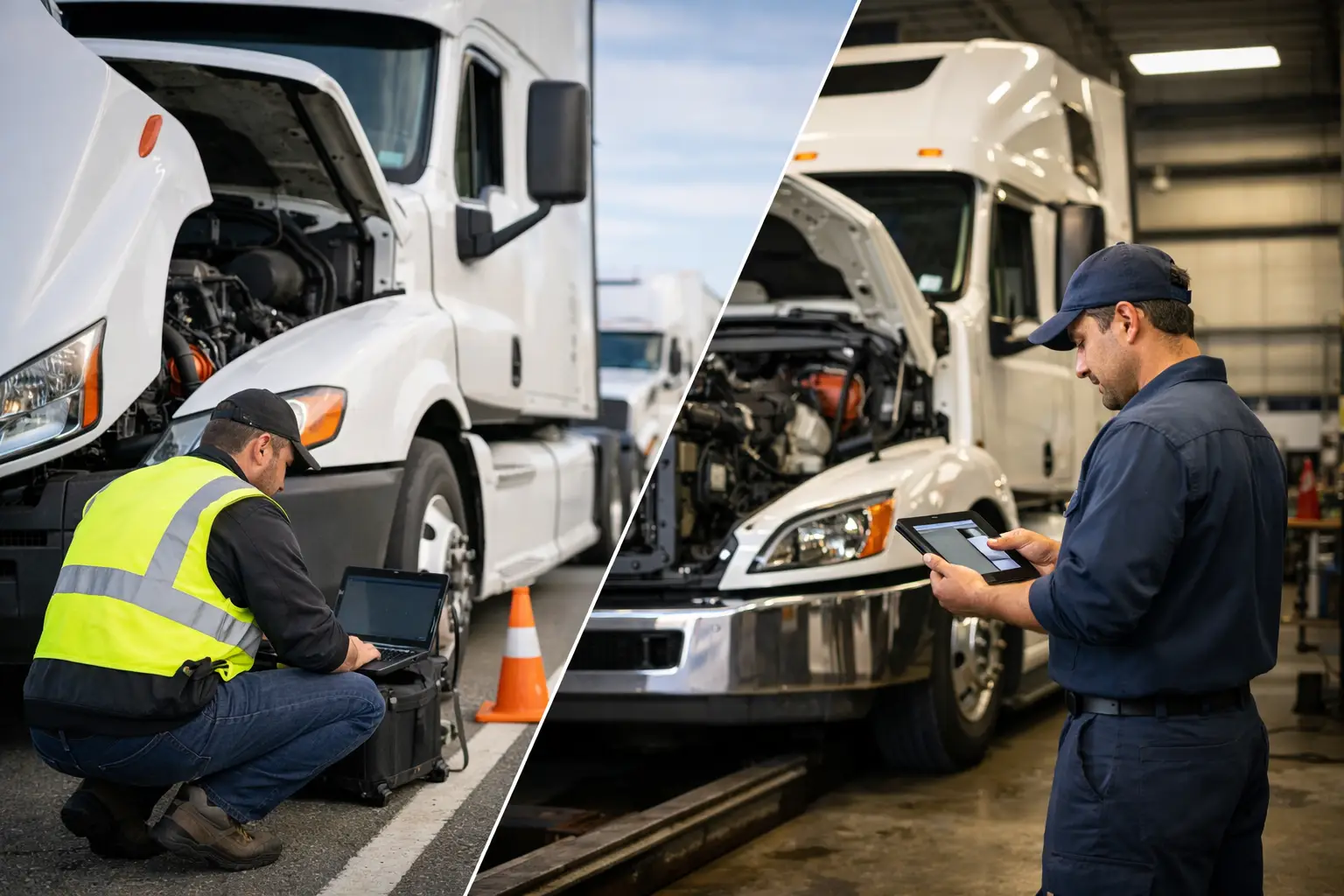
A dash warning on I-35, an engine that derates under load, or a DPF that refuses to complete a regen is not a problem that can wait for a convenient appointment. Roadside diagnostics vs shop diagnostics comes down to one operational question: can the fault be identified and corrected safely where the truck sits, or does it require the controlled conditions and equipment of a repair facility?
For commercial trucks, the answer is rarely as simple as pulling a fault code. Modern diesel systems are tied together through engine controls, aftertreatment components, air systems, electrical circuits, sensors, and communication networks. A good diagnosis has to explain what failed, why it failed, and whether putting the truck back in service will hold up through the next loaded run.
Roadside Diagnostics vs Shop Diagnostics: The Real Difference
Roadside diagnostics are built for speed, access, and decision-making under pressure. A mobile diesel technician arrives at the truck, connects professional diagnostic equipment, checks active and inactive fault codes, reviews live data, and inspects the systems most likely to cause the complaint. The goal is to isolate the fault and make a reliable field repair when conditions allow.
Shop diagnostics use the same technical foundation, but with more control. A facility can provide extended testing time, repeatable operating conditions, dedicated equipment, and easier access around the vehicle. That matters when a failure only appears under a specific load, temperature, vibration level, or duty cycle.
Neither approach is automatically better. The right choice depends on the truck's condition, the fault, the repair required, and the risk of returning the unit to service before the root cause is confirmed.
What Roadside Diagnostics Can Handle Well
Mobile diagnostics are especially effective when the issue is accessible, the truck can be evaluated safely where it is parked, and the repair does not require a long test cycle or major disassembly. For many roadside breakdowns, a qualified diesel technician can identify the cause without moving the truck at all.
Electrical and sensor-related faults are common examples. A technician can inspect damaged wiring, loose connectors, corroded terminals, poor grounds, blown fuses, and power or communication issues. Live data can show whether a pressure, temperature, NOx, speed, or position sensor is reporting values that make sense. A code may point to a component, but the data and circuit tests determine whether that component is actually the problem.
Air system issues also often fit the mobile repair model. Air leaks, faulty valves, damaged air lines, pressure problems, and related drivability or compliance concerns can frequently be located and corrected on-site. The same is true for many cooling, starting, charging, and A/C issues when the affected components are accessible and replacement parts are available.
Aftertreatment faults are another area where roadside capability matters. A failed regen is not always caused by a blocked DPF. It can be tied to soot-load calculations, exhaust temperature readings, differential pressure data, dosing performance, wiring faults, or operating conditions that prevented a normal regen. A technician with proper scan tools can review the fault history, check relevant sensor values, perform supported tests, and determine whether a stationary regen or targeted repair is appropriate.
The advantage is clear: diagnosis begins where the breakdown happened, while the driver, load, and dispatch schedule are still under pressure. For fleets operating around San Antonio and the I-35, I-10, I-37, and I-410 corridors, that response can prevent a small fault from becoming a full lost shift.
Where a Shop Has the Advantage
Some problems need more than a scan tool and a visual inspection. A controlled shop environment becomes the better diagnostic path when the truck must be run for an extended period, tested under repeatable load, lifted for access, or partially disassembled to verify the failure.
Intermittent faults are a major example. A truck may lose power only after two hours of highway operation, throw a communication code only when vibration increases, or develop an air leak only after a component heats up. If the condition cannot be reproduced at the roadside, replacing parts based on a single code is not a repair strategy. It is a gamble.
Complex engine performance complaints can also require deeper testing. Excessive crankcase pressure, persistent coolant loss, internal mechanical concerns, fuel delivery problems that appear only under demand, or issues requiring extended data capture may call for more time and controlled procedures than a roadside setting can provide.
Aftertreatment systems can fall into this category as well. If a forced regen is not permitted by the fault conditions, temperatures cannot be managed safely, or inspection points are difficult to access, a shop-level evaluation may be necessary. The correct decision protects the truck, the driver, and the emissions system from additional damage.
A shop is not simply a place for bigger repairs. Its real diagnostic advantage is repeatability. The technician can test, verify, repair, and test again without roadside traffic, weather, limited space, or pressure to rush a questionable result.
Fault Codes Are a Starting Point, Not a Verdict
One of the most costly mistakes in diesel repair is treating a fault code as a parts list. A code identifies a condition the engine control module detected. It does not always identify the failed part.
For example, a low-pressure code may be caused by a failed sensor, but it can also come from a damaged harness, a poor connector fit, an actual pressure problem, or a fault elsewhere in the system that changed the reading. Replacing the sensor without checking the circuit and the live data may clear the code temporarily while leaving the truck vulnerable to another breakdown.
The same principle applies to DPF, DEF, SCR, turbocharger, and electrical faults. Good diagnostics use fault codes alongside freeze-frame information, operating data, physical inspection, system knowledge, and verification after the repair. That process is what separates a quick guess from a field repair that is ready for service.
How to Decide Whether the Truck Can Stay Put
The first question is safety. If the truck is in an unsafe location, has an active condition that could cause further damage, or cannot be operated without creating a hazard, the diagnostic plan must account for that before anything else.
Next, consider whether the fault is stable and accessible. A no-start with a clear electrical issue may be a strong candidate for mobile repair. A damaged aftertreatment harness, failed pressure sensor, air leak, or charging-system problem may also be resolved on-site. These are conditions where a technician can test the system, complete the repair, and verify normal operation without needing a long road test.
A shop-level path makes more sense when the fault is intermittent, hidden, internal, or tied to operating conditions that cannot be recreated safely on the roadside. It is also the right call when the repair requires extensive access or the truck needs a prolonged verification cycle before it can be released with confidence.
For fleet managers, the key is to avoid making the decision based only on how quickly the truck can move again. A truck that leaves with the root cause unresolved can fail again at the next delivery window. The fastest outcome is the one that restores dependable operation, not merely temporary movement.
What a Strong Mobile Diagnostic Visit Looks Like
A professional roadside diagnostic process should be organized, even when the call is urgent. The technician needs the driver's complaint, dash messages, recent repair history if available, and details about when the issue began. Changes in power, fuel economy, exhaust behavior, air pressure, coolant temperature, or starting performance all help narrow the test plan.
From there, the work should move from evidence to confirmation. That includes reading codes, checking live parameters, inspecting the affected system, testing circuits or mechanical conditions, and confirming the repair. If the truck needs a shop environment, the diagnosis should clearly explain why. That gives the driver or fleet a defensible next step instead of a vague recommendation.
TX Road Service approaches mobile diesel diagnostics with that standard in mind: assess the actual fault, repair what can be repaired at the truck, and be direct when a deeper controlled test is the safer answer.
The Best Diagnostic Choice Is the One That Prevents the Next Stop
Roadside service is not a lesser version of shop work. With the right technician, scan tools, and testing discipline, it can resolve a wide range of diesel breakdowns where they occur. Shop diagnostics remain essential when a fault demands more access, more time, or more controlled verification.
When your truck is down, provide the clearest symptom details you can, protect the vehicle from further operation when warning signs are severe, and let the diagnostic evidence determine the repair path. That is how you get back to work with a repair you can trust.