Mobile Truck Repair Cost in San Antonio
What affects mobile truck repair cost in San Antonio? Learn how location, diagnostics, labor, parts, timing, and towing shape the total breakdown expense.
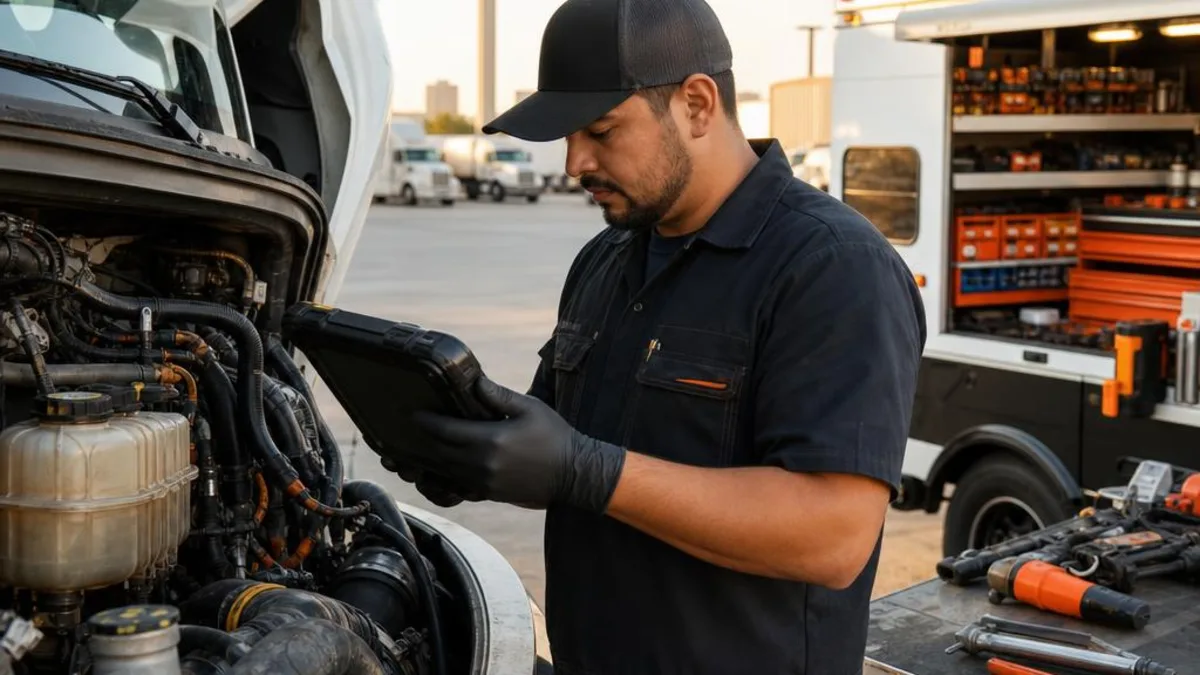
When a commercial truck stops moving, the first question is usually how quickly help can arrive. The next question is often what the repair will cost. There is no honest flat answer for mobile truck repair cost in San Antonio because the final amount depends on the truck, the failure, the location, the time of the call, and what testing or repair is needed on site.
That does not mean the price should be a mystery. A professional mobile diesel service should be able to explain what affects the bill, what information is needed before dispatch, and when a roadside repair is likely to make more financial sense than a tow. Understanding those factors helps owner-operators and fleet managers make a faster decision when every hour of downtime matters.
What usually makes up a mobile truck repair bill?
Most roadside service calls are built from a few basic parts. These can include the service call or dispatch, travel to the truck, diagnostic or labor time, parts and materials, and any special equipment required for the job. After-hours response, difficult access, or a location well outside the normal service area may also affect the total.
The important point is that arrival and repair are separate parts of the work. A technician still has to travel to the unit and identify the actual failure before anyone can know whether the truck needs a simple electrical repair, a hose, a sensor, a forced regeneration, an air-system repair, or a tow to a shop.
A quote based only on “my truck will not start” cannot account for every possible cause. A no-start might come from weak batteries, a charging-system problem, damaged wiring, fuel delivery, a starter circuit, an engine protection condition, or another fault. Accurate testing protects the customer from paying for parts that do not solve the problem.
The six biggest factors that affect roadside repair cost
1. The truck’s exact location
Travel distance matters. A truck at a San Antonio yard is different from a unit stopped farther out along I-10, I-35, I-37, or a rural connector. Clear location information helps dispatch estimate travel correctly and prevents wasted time searching for an entrance, gate, loading area, or safe shoulder access point.
Send a dropped map pin when possible. Include the highway direction, nearest exit or mile marker, business name, gate instructions, and a description of the truck. Better location details can shorten the response and help the technician plan a safe arrival.
2. The time and urgency of the call
Night, weekend, and holiday service may be priced differently from scheduled daytime work. Emergency response also requires a technician and service vehicle to be ready when normal parts counters or support options may be limited.
For a working truck, the lowest hourly rate is not always the lowest total cost. Waiting until the next business day may add missed delivery time, driver delay, hotel or parking costs, tow charges, and lost use of the equipment. The better comparison is the full cost of getting the truck safely back into service.
3. Diagnostic time
Modern diesel trucks can show similar symptoms for very different reasons. A derate warning, check-engine light, low power complaint, or failed regeneration should not be treated by guessing. The technician may need to scan fault data, inspect wiring and connectors, test voltage or pressure, check for leaks, and verify how related systems are operating.
Diagnostic time is productive work. It narrows the problem and determines whether a roadside fix is appropriate. A fast but incorrect parts replacement can cost more than a disciplined diagnosis because the original failure remains and the truck is still down.
4. The repair and parts required
A loose connection or damaged air line is a different job from a failed starter, cooling-system leak, aftertreatment fault, or compressor problem. Parts availability, truck configuration, access to the failed component, and the amount of disassembly all affect labor and material cost.
Giving dispatch the year, make, model, engine, unit number, and any visible fault codes improves preparation. Photos of the dash, leak, damaged component, or engine area can also help the technician bring likely materials without promising a diagnosis from a picture alone.
5. Whether the truck can be repaired safely on site
Many electrical, air, starting, charging, cooling, A/C, diagnostic, and regeneration-related problems can be handled where the truck sits. Other failures require shop equipment, extensive disassembly, controlled conditions, or repairs that would not be safe on a roadside shoulder.
A responsible mobile mechanic should tell you when field repair is not the right option. Paying for a correct diagnosis and a clear tow recommendation is better than spending hours attempting a repair that cannot be completed safely at the location.
6. Downtime beyond the repair invoice
The service bill is only one part of breakdown cost. A disabled commercial truck can also create driver-hour problems, missed appointments, detention, load risk, replacement-unit costs, and lost revenue. Fleets may need to consider the effect on dispatch and customer commitments as well.
That is why quick, accurate mobile diagnostics can be valuable even when the repair itself is not minor. Finding the cause at the truck lets the operator decide whether to repair, source a part, transfer a load, or arrange a tow without adding another round of guesswork.
Mobile repair versus towing to a shop
A tow is sometimes necessary, but it is not automatically the cheaper first step. Towing adds its own charge and moves the truck before the failure has been diagnosed. The shop may also have a wait before it can inspect the unit.
Mobile service is often the better first call when the problem is likely to be field-serviceable, the truck is in a safe accessible location, or an on-site diagnosis can prevent an unnecessary tow. A shop is more appropriate when the repair requires a lift, major internal engine or transmission work, extensive fabrication, or another controlled repair environment.
For more detail, see our guide to roadside repair versus shop repair.
What to provide when asking for a price estimate
The more useful information you provide, the more accurately the service provider can explain the likely call structure and prepare for the job. Before calling, gather:
- Your exact location and whether the truck is in a safe, accessible area
- Truck year, make, model, engine, and unit number
- The main symptom and when it started
- Dash warning lights, fault codes, or derate messages
- Whether the engine starts, cranks, runs, or moves
- Any visible leak, smoke, unusual sound, or recent repair
- Photos when they can be taken safely
Ask what the dispatch or service call covers, how travel and labor are handled, and whether approval will be requested before additional repair work begins. Clear communication protects both the operator and the technician.
Be cautious with a price that sounds too certain
A provider may be able to quote a known service-call structure, but a final repair price offered before anyone knows the failure should be treated carefully. Diesel symptoms overlap. The same warning can come from a failed component, wiring damage, low voltage, a leak, contamination, or a fault elsewhere in the system.
The goal is not to find the person willing to guess the smallest number over the phone. It is to get a qualified technician to the truck, identify the problem, explain the repair path, and help limit total downtime.
Get mobile truck repair in San Antonio
TX Road Service provides 24/7 mobile diesel diagnostics and commercial truck repair across the San Antonio area. We handle roadside and on-site calls involving no-starts, electrical problems, air systems, cooling issues, A/C, DPF and regeneration faults, and other heavy-duty truck problems.
To get the most useful response, call with the truck location, unit information, symptoms, and dash warnings ready. We can use those details to understand the situation, prepare for dispatch, and explain the next step. Review our mobile diesel repair services or call (210) 701-1287 for immediate help.