Forced Regen Versus Parked Regen Explained
Forced regen versus parked regen explained for truck drivers: learn the risks, warning signs, and when mobile diesel diagnostics are needed on the road.
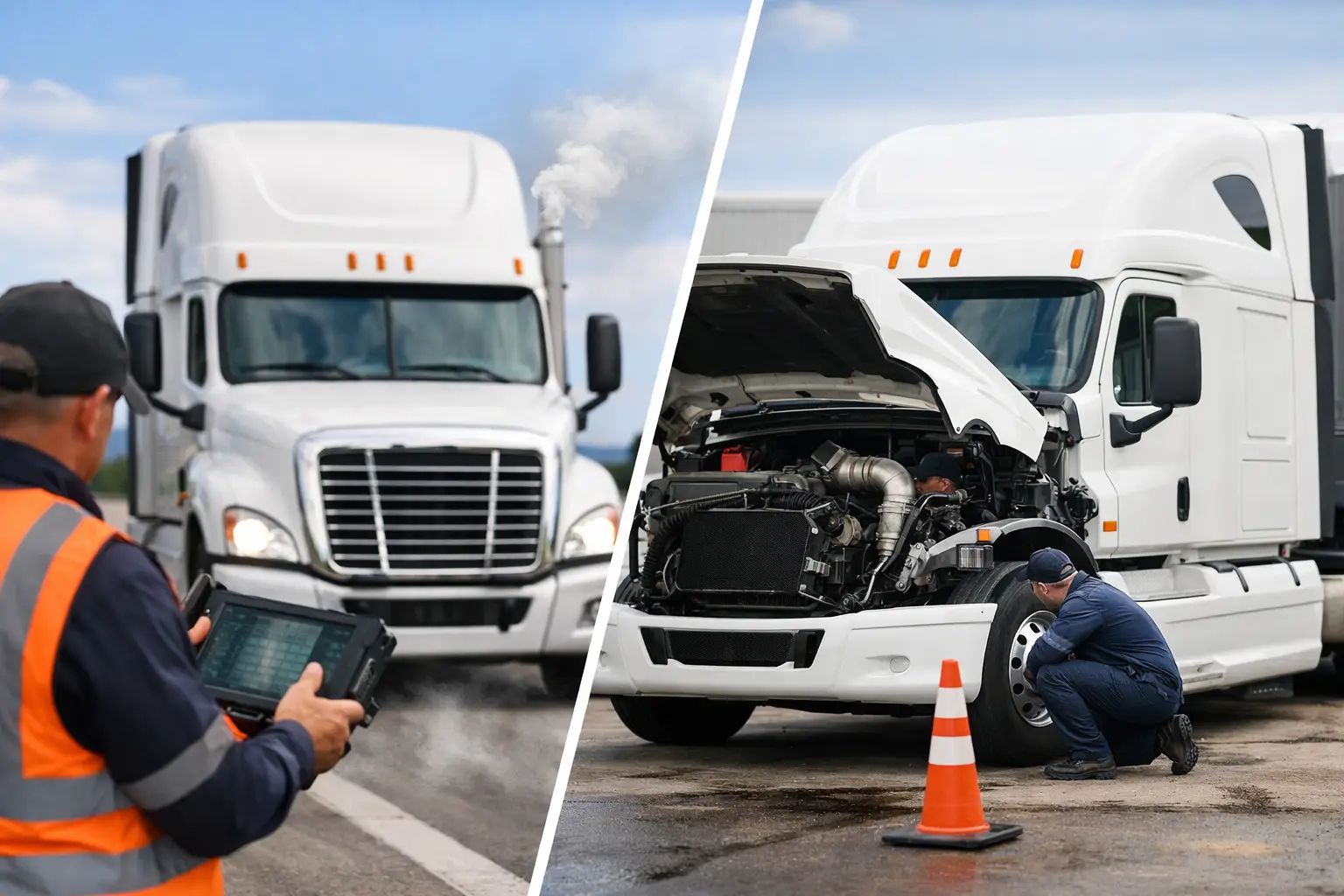
A DPF warning can turn a normal run into a deadline problem fast. Understanding forced regen versus parked regen helps drivers and fleet managers make the right call before a soot-loaded filter turns into derate, shutdown, or a truck sitting on the shoulder.
A parked regen is a driver-initiated cleaning cycle that the truck's ECM allows when operating conditions are safe and the fault status supports it. A forced regen is a diagnostic procedure commanded by a qualified technician using scan equipment, usually after determining why normal regeneration did not complete. They are not interchangeable, and treating them as if they are can create more downtime instead of less.
What a Parked Regen Is Designed to Do
A diesel particulate filter collects soot as the engine runs. Under the right conditions, the emissions system raises exhaust temperatures and burns that soot into ash. This is regeneration. Some regeneration happens automatically while driving, particularly during sustained highway operation. When the truck cannot complete that process on its own, it may request a parked regen.
A parked regen is performed with the truck stationary, typically through the dash controls. The ECM checks for required conditions before it will start. Those conditions vary by make and model, but usually include adequate fuel level, correct engine temperature, no critical engine or emissions faults, proper parking brake status, and a transmission position that confirms the truck is secured.
Once initiated, the engine speed may rise and the exhaust system reaches very high temperatures. The process can take 20 to 45 minutes, sometimes longer. The truck must be parked in a clear, safe area away from dry grass, fuel vapors, debris, people, and equipment that can be damaged by extreme heat.
The key point is simple: a parked regen is not a repair. It is a normal recovery procedure when the DPF has accumulated soot but the system still believes it can clean itself safely.
When a Parked Regen Makes Sense
A parked regen may be appropriate when the dash displays a regeneration request, the truck still runs normally, and there are no red stop-engine warnings or major drivability symptoms. It is often the correct first move after extended idling, low-speed work, frequent short runs, or stop-and-go operation that prevented a normal active regen from finishing.
It is not a good idea to repeatedly run parked regens just because a light returns. If the truck requests another regen soon after completing one, there is likely an underlying issue. The DPF may be loading too quickly, a sensor may be reporting incorrect data, or the engine may be producing excessive soot.
A successful parked regen should reduce soot loading and clear the appropriate warning condition. It does not remove ash from the DPF, fix a failed temperature sensor, repair an exhaust leak, or correct a fuel, air, EGR, or turbocharger issue that is causing the truck to smoke or over-fuel.
Forced Regen Versus Parked Regen: The Critical Difference
The main difference between forced regen versus parked regen is control and diagnosis. The truck controls and approves a parked regen through its normal operating logic. A technician commands a forced regen through diagnostic software after checking the system's data, fault codes, soot load, temperature readings, pressure readings, and enabling conditions.
A forced regen may be necessary when the truck refuses a parked regen, has moved into a power derate, or has stored fault codes that prevent the standard process from starting. The technician can use shop-level diagnostics to determine whether it is safe to command regeneration and monitor the event as it occurs.
That does not mean a forced regen is a universal fix. If the differential pressure sensor is failed, the exhaust temperature sensors are implausible, the DPF is physically restricted, or an active fault points to an engine-side problem, forcing a regen can be ineffective or unsafe. Clearing codes and commanding heat into a system with unresolved faults is not proper diesel repair.
In practical terms, a parked regen is the truck asking for help within its programmed limits. A forced regen is a technician taking control of the process after verifying what caused the system to reach that point.
Why the Truck May Refuse a Parked Regen
When a parked regen will not start, drivers often assume the DPF itself is bad. Sometimes it is, but several other problems can block the process. The ECM needs reliable sensor input and acceptable fault status before it will allow exhaust temperatures to climb.
Common causes include a failed DPF differential pressure sensor, damaged sensor tubing, faulty exhaust gas temperature sensors, an NOx sensor fault, low fuel, coolant temperature issues, EGR faults, boost leaks, exhaust leaks, or a soot load that has already exceeded the ECM's allowed limit. A truck can also reject a parked regen because a previous cycle was interrupted repeatedly.
The best next step is not to keep pressing the regen switch. A technician needs to read active and inactive codes, verify live data, and determine whether the reported soot load is real. A bad sensor can falsely show a loaded filter. On the other hand, a true restriction can be serious enough that regeneration alone will not restore normal operation.
Risks of Running the Wrong Regen
Regeneration produces intense heat. A forced procedure especially requires a controlled environment, monitoring, and a technician who understands the engine manufacturer's process. Exhaust components, nearby materials, and the DPF itself can be damaged if the procedure is attempted under the wrong conditions.
There is also a mechanical risk. If the engine has a fueling, airflow, or EGR problem, it may create soot faster than the DPF can process it. Repeated regeneration attempts can mask the real fault while adding unnecessary thermal stress to the aftertreatment system.
Drivers should stop and get diagnostics when a truck has a flashing DPF light, a red stop-engine warning, a severe power derate, abnormal smoke, high exhaust temperature warnings, or a parked regen that will not initiate or complete. Those are not conditions to ignore until the next delivery stop.
What a Proper Forced Regen Service Includes
A professional forced regen begins before the regen command. The technician checks fault codes, freeze-frame information, engine operating data, soot estimate, calculated ash load, DPF differential pressure, and exhaust temperature sensor readings. They also inspect for obvious wiring damage, damaged sensor lines, and exhaust leaks that can distort system readings.
If the system data supports regeneration, the technician commands and monitors the procedure with diagnostic equipment. Temperatures and pressure behavior during the event matter. A completed forced regen is only useful if the pressure readings, soot load, and fault status respond as expected afterward.
If they do not, the truck needs the underlying issue corrected. Depending on the diagnosis, that may involve sensor repair, wiring repair, exhaust repair, a DPF cleaning decision, or engine-side troubleshooting. This is why a completed regen screen does not automatically mean the truck is fixed.
Roadside Decisions That Protect Uptime
For owner-operators and fleets, the goal is not simply to get the warning light off. The goal is to prevent a manageable DPF issue from becoming a no-start, derate, or roadside shutdown. When the truck requests a parked regen and conditions are safe, perform it according to the manufacturer procedure and let it finish without interruption.
When the truck refuses the regen, returns the warning shortly afterward, loses power, or shows multiple emissions faults, move to diagnostics. TX Road Service provides mobile diesel diagnostic and regen support for commercial trucks across San Antonio and major surrounding freight corridors, helping identify whether the truck needs a monitored forced regen or a repair before one is attempted.
A DPF system gives warnings for a reason. Treat a parked regen request as a scheduled opportunity to clean the filter, and treat a failed regen request as a reason to find the fault before it costs the next load.